
Key Takeaways
EA nonlawyer virtual assistant can support law-firm administration, but the lawyer remains responsible for supervision, professional judgment, confidentiality, and compliance with the rules that apply in the firm’s jurisdiction.
- Common support: intake administration, scheduling, document formatting and organization, billing follow-up, file management, and calendar support
- Lawyer-only responsibility: legal advice, legal strategy, professional judgment, and supervision of nonlawyer work
- Confidentiality: firms need appropriate agreements, access controls, procedures, and supervision when a nonlawyer handles information relating to a representation
The exact scope should be set by the supervising lawyer under applicable state rules and the firm’s own policies.
Important: This article provides general information about administrative support. It is not legal or ethics advice. Professional-conduct rules vary by jurisdiction, so firms should apply the rules and guidance that govern their practice.
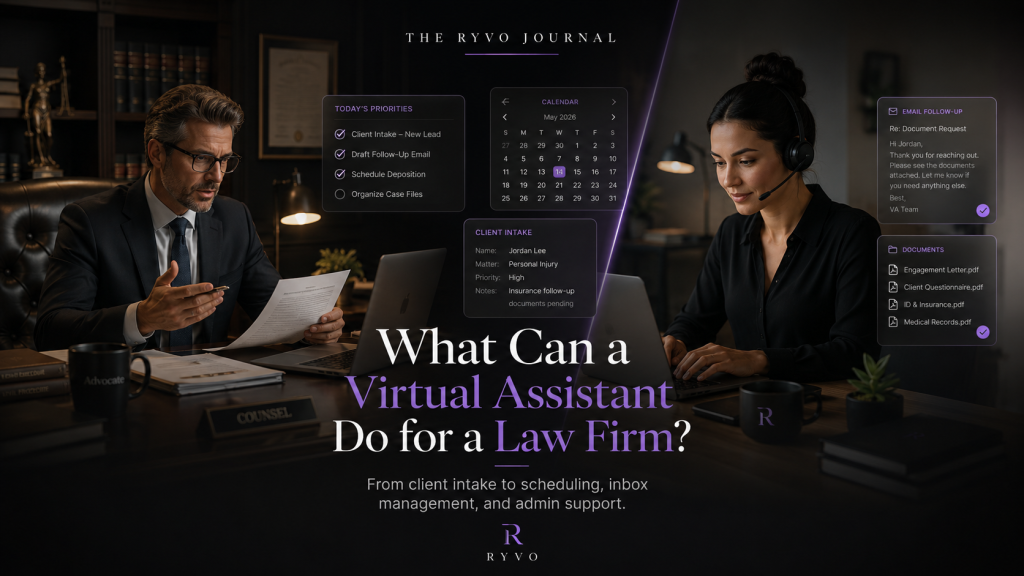
Law firms often have substantial administrative work around client matters: intake coordination, scheduling, document organization, billing follow-up, and calendar maintenance.
A remote nonlawyer assistant can support many of those workflows, but the arrangement must preserve the lawyer’s duties of supervision, confidentiality, competence, and professional judgment.
Here’s what a great assistant actually does inside a busy practice, where the boundary sits, and how to delegate without creating a compliance headache.
What a legal VA handles day to day
A legal virtual assistant can support administrative workflows, provided the supervising lawyer defines the role, reviews the work appropriately, and keeps legal judgment with licensed professionals.
Client intake and scheduling
First-contact response, intake-form administration, gathering information required by the firm’s established conflict-check process, and scheduling consultations. The assistant can collect and organize information; conflict determinations and legal judgments remain with the lawyer or firm personnel authorized to make them.
Document preparation and management
Formatting, proofreading, organizing files, assembling materials, and preparing template-based documents under attorney direction. The supervising lawyer remains responsible for substantive legal judgment and the final work product.
Billing and collections support
Administrative billing support can include time-entry follow-up, invoice preparation, and routine follow-up on outstanding balances under the firm’s procedures. Delegating this work can reduce administrative load, but the financial impact depends on the firm’s workflow, volume, and collection practices.
Calendar and deadline management
Maintaining calendar and docket entries, routing reminders, and following the firm’s documented deadline procedures. Lawyers remain responsible for supervision and for meeting the legal deadlines that govern a matter.
The operating principle: Administrative delegation can create capacity, but the law firm—not the assistant—owns the professional obligations. Define procedures, access, escalation points, and supervision before handing over sensitive workflows.
Where the boundary sits
The boundary is not simply remote versus in-office; it is whether the work is being performed under appropriate lawyer supervision and without delegating legal judgment or unauthorized practice.
The relevant boundary is professional responsibility. ABA Model Rule 5.3 states that lawyers with managerial or supervisory authority must make reasonable efforts to ensure that nonlawyer assistance is compatible with the lawyer’s professional obligations. The lawyer remains responsible for appropriate supervision and cannot use delegation to transfer professional judgment or responsibility.
The ABA has also recognized that lawyers may outsource legal or nonlegal support services while remaining ultimately responsible for competent legal services. The details can vary by jurisdiction, so firms should apply their own state rules and ethics guidance before defining the assistant’s scope.
Confidentiality and discretion
Confidentiality requires more than an NDA: the firm should use reasonable safeguards, appropriate access controls, clear procedures, and supervision for information relating to client representations.
Confidentiality requires a systems approach. ABA Model Rule 1.6 and its comments require lawyers to make reasonable efforts to prevent unauthorized access to or disclosure of information relating to a representation. For nonlawyer assistance, that can include confidentiality agreements, role-based access, secure tools, written procedures, training, and ongoing supervision.
Administrative support with discretion built in.
Ryvo takes an NDA-by-default, discretion-first approach to executive-assistant support. Law firms should still configure access, supervision, and workflows around the professional obligations that apply to their practice.
Book an Intro CallWhere to start
A practical starting point is repeatable administrative work with clear procedures and close supervision before expanding the assistant’s access or responsibilities.
Begin with repeatable administrative work that has clear procedures and limited decision rights—for example intake administration, scheduling, file organization, or billing follow-up. Expand the role only as the firm establishes appropriate supervision, access controls, and confidence in the workflow.
Professional-responsibility sources: This guide is informed by ABA Model Rules 1.6 and 5.3 and ABA guidance on outsourcing legal and nonlegal support. State rules can differ, so the supervising lawyer should confirm the requirements that apply to the firm and matter.
Common questions
Law firms can use nonlawyer support, but the supervising lawyer remains responsible for professional obligations and the appropriate scope of delegated work.
Can a virtual assistant do legal work?
Can a virtual assistant do legal work? A nonlawyer assistant can support administrative and delegated workflows under appropriate lawyer supervision, but the lawyer remains responsible for professional judgment, competent legal services, and compliance with rules governing unauthorized practice and nonlawyer assistance.
Is it safe to share case information with a virtual assistant?
It can be appropriate when the firm has a lawful basis to share the information and uses reasonable safeguards, appropriate confidentiality terms, secure access, clear procedures, and supervision. The requirements can vary by jurisdiction and matter.
What should a law firm delegate first?
Start with repeatable administrative workflows that have clear procedures and limited decision rights, such as intake administration, scheduling, file organization, and billing follow-up. Expand access and responsibility only as supervision and controls are established.