
Key Takeaways
Job titles vary by company, but a useful distinction is that virtual assistants are often hired for defined remote tasks, while executive assistants are more often expected to work with broader context, prioritization, and judgment.
- Virtual-assistant fit: repeatable work with clear inputs, rules, and outputs.
- Executive-assistant fit: work that requires context, prioritization, stakeholder coordination, and discretion.
- The important question: not which title sounds more senior, but how much judgment the role must exercise.
If the work can be specified almost completely in advance, task-oriented VA support may be enough. If the role must interpret priorities and act with context, EA-level support may be a better fit.
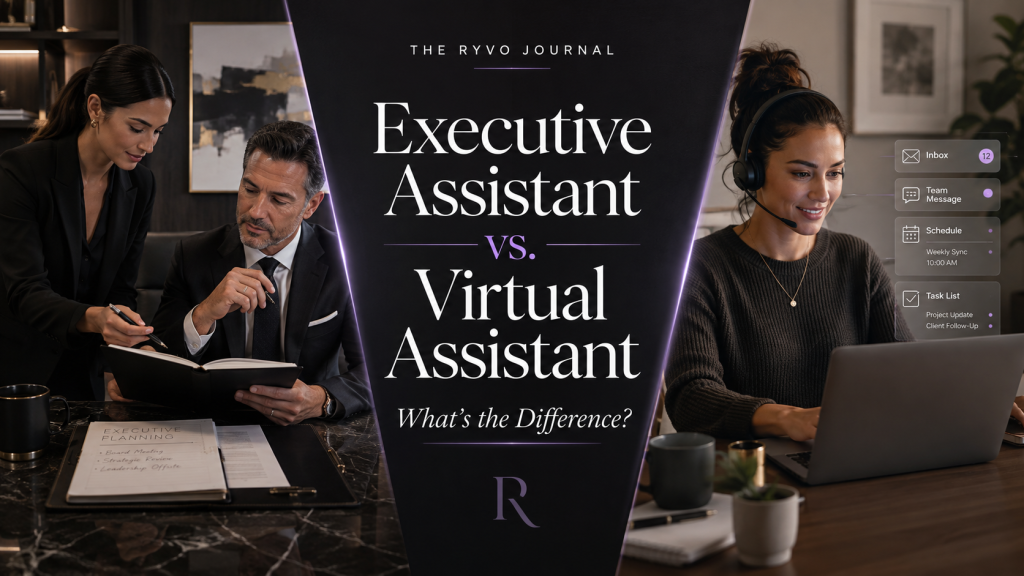
“Executive assistant” and “virtual assistant” are often used interchangeably, but employers and service providers do not define the titles consistently. The better way to compare them is by the scope of the role: how much context, judgment, prioritization, and ownership the person is expected to carry.
Here’s the clean version of the distinction, and a simple way to tell which one you actually need.
The core difference
The most useful distinction is scope: task-oriented support follows defined instructions, while executive-level support is expected to work with broader context and judgment.
A virtual assistant is often engaged for defined remote tasks such as data entry, scheduling, research, CRM updates, or inbox organization. In many roles, the work is repeatable and can be described with clear rules and outputs.
An executive assistant is more often expected to work with broader executive context. That can include preparing for travel and meetings, protecting focus time, coordinating stakeholders, and making routine prioritization decisions within agreed boundaries.
A virtual assistant does the task you assign. An executive assistant owns the result you care about. That’s the whole distinction in one line.
Quick test: If the work can be specified almost completely in advance, task-oriented VA support may be enough. If the role must interpret priorities, coordinate stakeholders, and make routine judgment calls within agreed boundaries, EA-level support may be a better fit.
What each one handles
Both roles can overlap on administrative work; the difference usually appears in how much ambiguity, prioritization, and stakeholder responsibility the role carries.
Virtual assistant territory
- Data entry, list-building, and CRM updates
- Basic scheduling against clear rules
- Research with a defined brief
- Inbox sorting and templated replies
- Formatting, transcription, and admin tasks
Executive assistant territory
- Calendar strategy — protecting focus time, resolving conflicts, deciding what’s worth your hour
- Inbox management with judgment about what reaches you and what they handle
- Meeting prep: agendas, background, and the “here’s what you need to know” brief
- Stakeholder communication in your voice
- Light project and team coordination
- Anticipating needs before you name them
The cost difference, and why it exists
Compensation tends to rise as a role requires more experience, context, autonomy, and judgment, but title alone is not a reliable pricing benchmark.
Pricing varies by experience, geography, service model, and scope. Roles that require more context, autonomy, and judgment often command higher compensation, but the title itself does not determine the price. For current benchmarks, see our executive assistant cost guide.
Which one do you actually need?
Choose the role based on the bottleneck you need to remove: task volume points toward VA support, while judgment and coordination point toward EA-level support.
Choose a VA if your bottleneck is volume — lots of well-defined work you simply don’t have hands for. Choose an EA if your bottleneck is you — decisions, coordination, and judgment piling up because there’s only one of you to make them.
Founders whose bottleneck is judgment, prioritization, and coordination rather than sheer task volume may get more value from EA-level support. The role should be defined around the decisions and outcomes you want to delegate, not the title alone.
Not sure which role fits your week?
Ryvo focuses on executive-assistant support for founders and CEOs. An intro call can help clarify the responsibilities, level of judgment, and working model your role actually requires.
Book an Intro CallCommon questions
There is no universal title standard, so define the responsibilities, decision rights, and expected level of autonomy before hiring.
Is an executive assistant just a senior virtual assistant?
Not necessarily. Titles vary by company. A more useful distinction is the scope of the role: executive-assistant positions are often expected to carry more context, prioritization, judgment, and stakeholder coordination.
Can one person do both roles?
Yes. The task lists can overlap substantially. The key is to define the level of autonomy, context, and judgment you expect rather than relying on the title alone.
Which is better for a founder?
It depends on the bottleneck. A founder with a backlog of clearly defined tasks may be well served by a VA, while a founder who needs higher-context coordination and prioritization may benefit more from an executive assistant.